How did we get here?
Basics
-
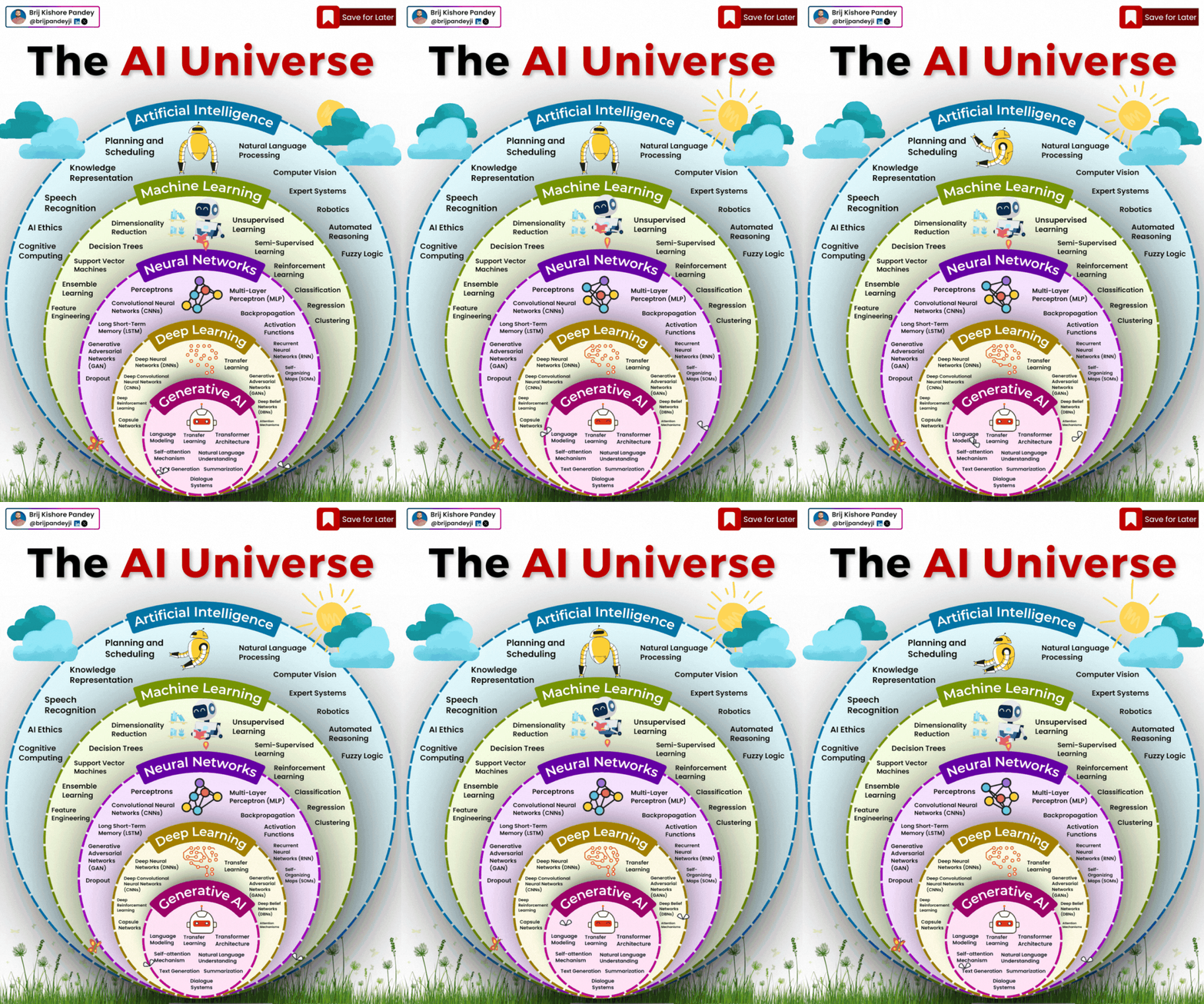
Artificial Intelligence (1956): Development of systems that can perform tasks that normally require human intelligence.
-
ELIZA (1966): Chatbot that simulates a therapeutic conversation using rules (searches for key words and responds with predefined phrases).
-
Deep Blue (1997): Computer that defeats Kasparov in chess. Programmed strategies and great calculation capacity.
-
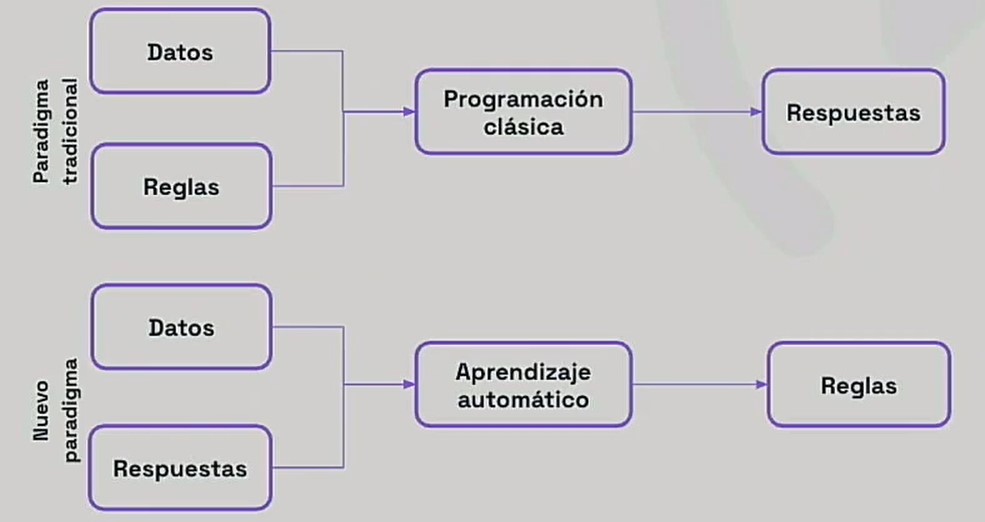
Machine Learning or automatic learning (1959): Development of algorithms and models that allow computers to learn from data.
-
Decision trees (1960), Logistic regression (1958), K-means (1967), SVM (1995), Random Forest (2001), Gradient Boosting (2001), etc.
-
Predictions based on data (stock market, weather, etc.)
Moravec Paradox (1980): It is relatively easy to make computers perform mathematical and logical operations, but it is difficult to make them perform simple tasks that any 4-year-old can do. do, like recognizing an object or understanding natural language.
-
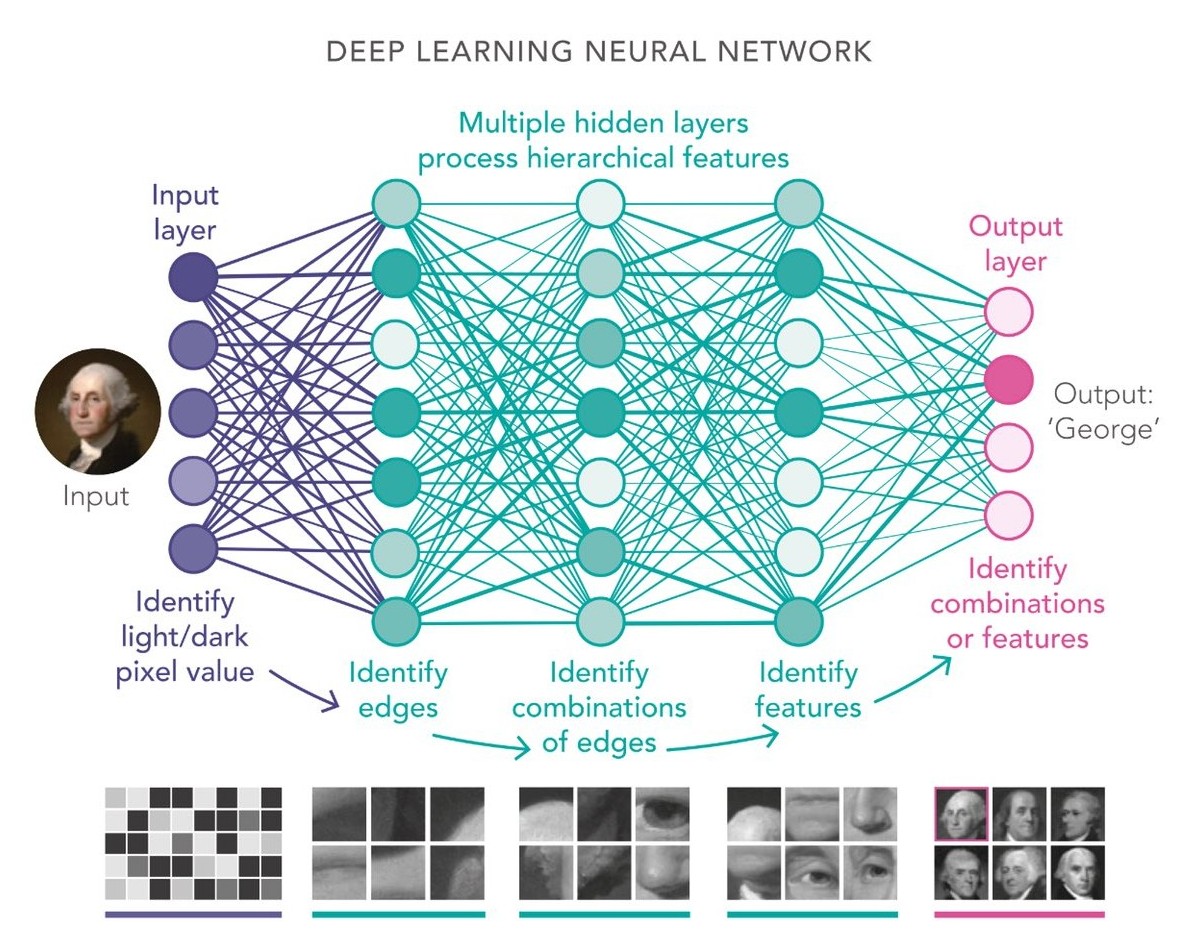
Artificial neural networks: They imitate the functioning of neurons in the human brain for Machine Learning applications.
-
Artificial neuron (1943)
-
Perceptron (1957)
-
Hopfield Network (1982)
-
Backpropagation (1986)
-
LeNet-5 (1998) (digit recognition)
-
Deep Learning: Subfield of AI that focuses on the development of deep neural networks (neural networks with many hidden layers) and with which the AI boom develops. -AlexNet (2012)
- Generative AI: Field of AI that uses Deep Learning in the creation of systems that can generate new and original content.
- ChatGPT, Dall-E, Sora, etc.
- What today has been called "The AI" thanks to the recent boom in generative models.
The AI Boom (from deep learning)
-
Causes:
-
Increase in computing capacity (GPUs, TPUs)
-
Availability of huge data sets (Internet, Big Data)
-
Advances in algorithms and network architectures
-
Great increase in industrial financing and investment
-
Main milestones:
-
2012: AlexNet reduces the error in ImageNet to 15.3% (previously 26%), demonstrating the power of convolutional neural networks and marking the beginning of the boom.
-
2014: Facebook's DeepFace achieves near-human accuracy (97.35%) in facial recognition.
-
2014: GANs (Generative Adversarial Networks) revolutionize content generation.
-
2016: DeepMind's AlphaGo defeats world champion Lee Sedol.
-
2017: The Transformer architecture appears, transforming language processing.
-
2020: OpenAI's GPT-3 demonstrates emerging capabilities in large-scale language models.
-
2021: diffusion models (DALL-E, GLIDE) begin to dominate the generation of realistic images.
-
2022: ChatGPT (GPT-3.5) by OpenAI popularizes conversational assistants.
-
2023: GPT-4 by OpenAI and proliferation of multimodal models (text, image, audio, video).
-
2024: First models with advanced reasoning capabilities (OpenAI o1).
-
2025: DeepSeek-R1 (open-weights) lowers the cost of language models with performance similar to o1.
Future expectations:
Augmentation of human capabilities (Human Augmentation)
AI is emerging as a collaborator that will enhance our skills. From assisting with complex tasks and decision making to overcoming physical or cognitive limitations, AI will act as an extension of our own capabilities.
Generative Audiovisual Creation
Advances in broadcast models, generative video and audio synthesis are transforming audiovisual production. Among the most relevant expectations are:
- High fidelity generative video: Models such as Sora (OpenAI), Pika or Runway Gen-2 will allow you to create complete cinematographic sequences from simple textual descriptions.
- Music and sound: Tools such as Stable Audio, LMusic or Sunshine will compose soundtracks and effects adapted to the context in real time.
- Mixed reality and video games: Worlds and characters that are dynamically generated, adjusting to the style and preferences of each player.
- Automated post-production: Editing, color correction, dubbing and subtitling processes guided by AI, drastically reducing production times.
- Increased accessibility: Automatic generation of audio descriptions, translations and sign language, expanding the scope of the content.
These advances, although focused on creativity, share with automation the ability to accelerate workflows and break down technical barriers, which is why they deserve their own section.
Self-Employed Agents
They represent the natural evolution of chatbots towards truly proactive and independent systems.
What is an AI Agent? Key Differences:
- Traditional chatbot: "How can I help you?" → Answer each individual question.
- Self-employed agent: "Organize my trip to Rome" → Plan, look for options, compare prices, make reservations, manage unforeseen events and inform you of the final result.
Fundamental characteristics of agents: They are defined by their autonomy to act in the long term, proactivity to take the initiative, reactivity to adapt to the environment, social capacity to interact and the use of tools (APIs, Internet, etc.).
Examples and featured applications:
- Personal management: Automatic travel planning (Kayak), finance management or coordination of household tasks.
- Professional scope:
- Programming: Software development with Devin AI or GitHub Copilot Workspace.
- Research and legal: Analysis of information with Perplexity Pro or review of contracts with Harvey AI.
- Impact sectors: Already used in customer service (Zendesk), logistics and algorithmic trading.
AI in Education
Artificial intelligence will transform the educational landscape, creating a more personalized, efficient and accessible learning environment.
- Personalized and intelligent tutoring: AI systems will act as individual tutors for each student, adapting the content and pace of learning to their specific needs. They will provide instant feedback, resolve doubts and offer reinforcement in areas where the student presents difficulties.
- Creation of dynamic educational content: Teachers will be able to use AI tools to generate customized educational materials, such as lesson plans, exercises, evaluation rubrics, interactive presentations and simulations. This will allow for richer and more diversified teaching with less effort.
- Automation of administrative tasks: AI will free educators from repetitive tasks such as marking exams, managing schedules or communicating routines, allowing them to focus on direct interaction with students and designing meaningful learning experiences.
- Accessibility and inclusion: AI technologies will eliminate barriers for students with special needs. Tools such as real-time transcription, simultaneous translation or advanced screen readers will ensure that all students have the same opportunities to access information.
- Learning analysis and early detection: AI will analyze patterns in student performance to proactively identify potential learning difficulties. This will allow educators to intervene early and offer the necessary support before problems escalate.
- Professional development for teachers: AI will also be able to assist teachers themselves, offering analysis of their teaching methods, suggesting new pedagogical strategies and facilitating access to continuing training resources.
Artificial General Intelligence (AGI)
What exactly is AGI?
- Broad definition: A system that can perform any cognitive task that a human can do.
- Strict definition: A system that not only equals but significantly outperforms humans in most economically valuable tasks.
- The problem: There is no scientific consensus on what exactly constitutes "general intelligence" or how to objectively measure it. Researchers such as Yann LeCun (Meta) argue that the term AGI itself is imprecise and that intelligence is a multidimensional spectrum achievable only through gradual advances.
Expected milestones towards AGI:
- Next 2-5 years: Models that outperform humans in most individual cognitive tasks (writing, programming, analysis, etc.).
- 5-10 years: Systems that can combine multiple skills in a coherent way and maintain long-term context.
- 10-20 years: Possible emergence of systems that demonstrate abstract reasoning, genuine creativity and autonomous learning comparable or superior to humans.